
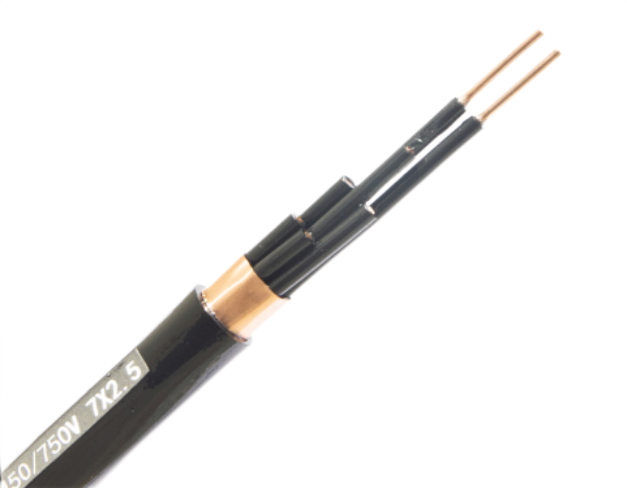
Control cable vs instrumentation cable is decided by signal level and screening. A control cable (KVV/KYJV) is a 450/750 V multi-core product, 2–61 cores at 0.5–10 mm², for switching, signalling and interlock circuits. An instrumentation cable (DJYVP/KVVP) is 300/500 V, 0.5–2.5 mm², individually and collectively screened for low-level analog and digital signals. Where a safety circuit must keep working during fire, a mineral insulated cable rated 0.6/1 kV is specified instead.
Control cable vs instrumentation cable: what each one actually carries
A control cable is built to switch and distribute power to devices rather than to measure anything. In the KVV / KYJV family the rating is 450/750 V, with 2 to 61 cores and cross sections from 0.5 to 10 mm², made to GB/T 9330 and IEC 60227. KVV uses a PVC insulation and sheath; KYJV substitutes XLPE, which in normal industry practice raises the continuous conductor limit from about 70 °C to 90 °C — always confirm the exact figure on the datasheet. These cables land in motor control centres, relay panels and interlock circuits, where the conductor has to carry coil or auxiliary current reliably and survive fixed installation. Mechanical protection, core count and voltage rating dominate the choice; screening is optional unless the plant specifies it.
An instrumentation cable carries the small signals that represent a process value: 4–20 mA loops, thermocouple and RTD wiring, pulse outputs and fieldbus links. The DJYVP / KVVP family is rated 300/500 V with 0.5–2.5 mm² cores arranged as cores, pairs or triples, made to GB/T 9330 and TICW. Its defining feature is shielding — individual screens around each pair or triple plus an overall screen — which keeps a nearby contactor or variable-speed drive from injecting noise into a measurement. Flame-retardant construction is a documented option, and a type-test report (for example Shenyang PQSI report 2025501WSDQ00004 for the instrument-shielded range) is the evidence to request, not a catalogue badge.
Using the wrong family is a real failure mode. Put a 4–20 mA loop on an unscreened control cable and it may read correctly on the bench but drift once it runs beside a drive. Use a 300/500 V instrument cable for a 450/750 V switching circuit and you have underspecified the insulation. The practical difference is therefore four numbers to check every time: voltage rating, core size, screening arrangement and the applicable standard. Treat control cable vs instrumentation cable as a functional decision, not a price comparison.
How to choose between control cable and instrumentation cable
Start with the circuit list, not with a cable catalogue. For each circuit write down whether it switches a load or carries a measured value, its voltage, the number of cores or pairs, the cross section, and whether it leaves a screened cabinet. Loads and interlocks point to control cable; low-level measurement and communication point to instrumentation cable. Then add the environment: ambient temperature, fixed installation or movement, exposure to oil or moisture, and the flame or smoke behaviour the project requires. An LSZH sheath is the usual request for enclosed or occupied spaces, and it should be specified explicitly rather than assumed.
Screening and installation decide whether the choice works in practice. Where signal and power routes share a tray, segregate them and respect the bend radius stated for the construction; individual-plus-overall screening (DJYPVP or equivalent) is the right answer for loops passing drives or long parallel power runs. Bond screens as the system design requires — the earthing method is a system decision, not a cable catalogue option. None of this makes a fixed-installation cable suitable for a moving energy chain: a drag chain needs a dedicated flexible construction with a declared bending-cycle life, and a solar string needs a DC-rated cable to IEC 62930. Do not stretch either family beyond its documented duty.
One more question changes the answer for safety circuits: must this circuit keep working during a fire? Ordinary control and instrumentation cables are not designed to maintain circuit integrity under flame and shock. For emergency shutdown, fire-pump control or alarm annunciation in a fire-risk area, a mineral insulated cable for fire survival applications becomes the relevant specialty option, with a copper sheath and mineral insulation that does not propagate fire. Ask for the corresponding circuit-integrity type-test report and treat it as a separate line in the specification — do not assume a flame-retardant sheath covers this duty.
Fire survival: how long does MI cable survive in fire, and what to verify
The documented mineral-insulated range uses copper conductors, magnesium-oxide insulation and a copper sheath, rated 0.6/1 kV with 1 to 4 cores and sections from 1.5 to 400 mm² on request, to GB/T 13033 and IEC 60702. The construction does not propagate fire and maintains circuit integrity at high temperature, which is why it appears in life-safety and critical circuits. The trade-offs are real: the sheath is stiff, bending needs planning, and terminations must be made with the correct accessories and by trained hands. Budget for those details rather than treating the cable as a drop-in replacement for a flexible control cable.
So, how long does MI cable survive in fire? There is no honest single number that applies to every construction. Survival time is a circuit-integrity classification that must be demonstrated by a test on the exact cable — IEC 60331-1:2018, for example, specifies a method for cables required to maintain circuit integrity under fire and mechanical shock at a flame temperature of at least 830 °C. The declared duration (commonly expressed as 30, 60, 90 or 120 minutes) should come from that cable's type-test report, not from a general claim about mineral insulation. Ask the supplier for the report, confirm the model number on it matches the product offered, and write the required classification into the purchase specification.
For a quotation on either family, send the circuit function, voltage, cores and cross section, screening requirement, fire classification if any, route length, installation method and maximum ambient temperature. A supplier working from that data can state clearly whether a standard control cable, an instrument cable or a fire-survival mineral insulated cable is the correct answer — and where the requested duty falls outside a documented product family.
Frequently asked questions
What is the difference between control cable and instrumentation cable?
Control cable (KVV/KYJV) is a 450/750 V multi-core cable, 2–61 cores at 0.5–10 mm², for switching, signalling and interlock circuits. Instrumentation cable (DJYVP/KVVP) is 300/500 V, 0.5–2.5 mm², with individual and overall screening for low-level 4–20 mA, thermocouple and fieldbus signals. Voltage rating, core size and screening — not appearance — decide which one fits.
How do I choose between control cable and instrumentation cable for a panel?
List each circuit first: loads, coils and interlocks go on control cable; analog measurements and communication go on screened instrumentation cable. Note the voltage, core count, cross section and whether the route passes drives or power trays. Segregate signal from power, respect the bending radius, and specify sheath and fire behaviour explicitly. If the circuit must operate during fire, move to a fire-survival mineral insulated cable.
How long does MI cable survive in fire?
There is no universal duration: it is a circuit-integrity classification proven by a type test on the exact cable. IEC 60331-1:2018 covers testing under fire and mechanical shock at a flame temperature of at least 830 °C. Common declared classes are 30, 60, 90 or 120 minutes, but the value for your cable must come from its own test report, matched to the offered model number.
When do I need a mineral insulated cable for fire survival applications?
Specify it when a circuit must remain operational during fire — emergency shutdown, fire-pump control, alarm annunciation or other life-safety loops. The documented BTTZ/YTTW/BTTW range is rated 0.6/1 kV, 1–4 cores, 1.5–400 mm², with magnesium-oxide insulation and a copper sheath to GB/T 13033 and IEC 60702. Plan for a stiff sheath, controlled bending and trained termination, and require the circuit-integrity report.
Sources & attributed quotations
“IEC 60331-1:2018 specifies the test method for cables which are required to maintain circuit integrity when subject to fire and mechanical shock under specified conditions.”
— International Electrotechnical Commission, IEC 60331-1:2018 — Tests for electric cables under fire conditions, Circuit integrity, Part 1 · official source
“The purpose of this standard is to specify mineral insulated cables that are safe and reliable when properly used, to state the manufacturing requirements and characteristics to achieve this, and to specify methods for checking conformity with those requirements.”
— International Electrotechnical Commission, IEC 60702-1:2002 — Mineral insulated cables and their terminations with a rated voltage not exceeding 750 V, Part 1: Cables · official source