
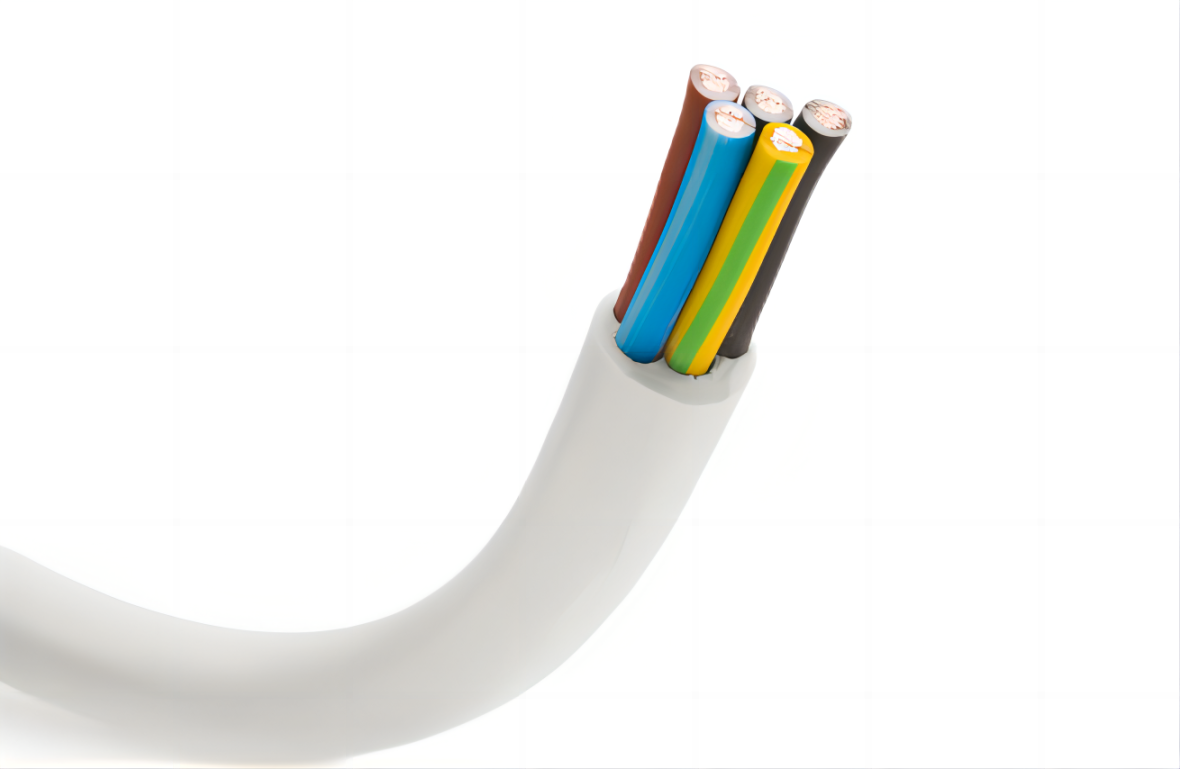
A drag chain cable is built for continuous flexing — fine-stranded conductors, a strain-relief core and a tough, low-friction sheath rated for millions of bend cycles with a defined minimum bend radius. A regular flexible cable (such as H05VV-F) tolerates occasional movement but fails quickly under constant high-speed flexing. If the cable moves in a cable carrier every machine cycle, specify a true drag-chain cable.
Built for motion, not just flexibility
Regular flexible cable uses fine strands to be bendable during installation, but its insulation and sheath are not designed to slide against themselves thousands of times a day. In a cable carrier, conductors fatigue, the sheath abrades and cores migrate. Drag chain cable addresses each failure mode with fine-wire bunching, a central strain-relief element and an abrasion-resistant outer sheath.
Bend radius and cycle life
Two numbers define a drag chain cable: minimum bend radius (often 5–10× cable diameter, sometimes less for continuous-flex designs) and bend-cycle rating (commonly 5–10 million cycles). Always check both against your carrier's radius and travel speed. Exceeding the bend radius or packing the carrier too tightly is the most common cause of premature failure.
Shielding and servo applications
For servo motors and encoders, use a shielded drag-chain cable with a fine-wire braid that survives continuous motion without the shield breaking. Pairing signal and power cores in one cable reduces space and ensures matched flex life. Pay attention to the sheath material: PU offers better abrasion resistance, while PVC is more economical for lighter-duty carriers.
Frequently asked questions
How many bend cycles can a drag chain cable handle?
A purpose-built drag chain cable is typically rated for 5 to 10 million bend cycles. Actual life depends on bend radius, travel speed, temperature and how tightly the carrier is packed.
Can I use regular flexible cable in a cable carrier?
Not recommended. Regular flexible cable is designed for occasional bending during installation, not continuous high-cycle flexing. It will abrade and fatigue early in a moving carrier.
What is the minimum bend radius for drag chain cable?
It varies by construction — commonly 5 to 10 times the cable outer diameter, and lower for special continuous-flex designs. Always follow the manufacturer's stated minimum for your specific cable.
Sources & attributed quotations
“Cables in cable chains must be specifically designed for continuous flexing and are tested for a defined number of bending cycles.”
— International Electrotechnical Commission, IEC 60227 / EN 50525 flexible cable standards · official source