
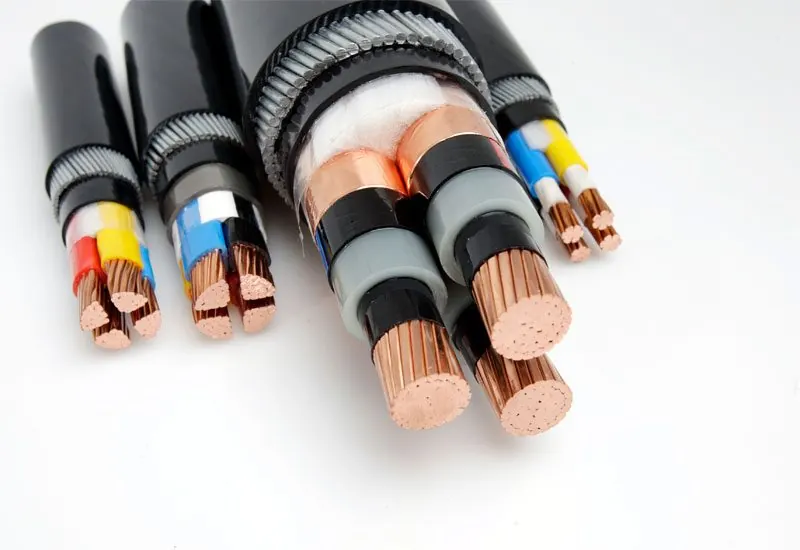
Fire resistant cable standards separate flame propagation from circuit integrity. IEC 60331-1:2018 tests cables rated up to 0.6/1 kV and over 20 mm at a flame of at least 830 C with mechanical shock, while the circuit must keep conducting; IEC 60331-2 covers cables up to 20 mm. Ask for the report on the exact construction, voltage and required duration.
Fire resistant cable standards: what IEC 60331 actually tests
Fire resistant cable standards are often treated as one marketing label, but the IEC family separates two questions. Flame-retardant tests ask whether a cable stops burning; circuit-integrity tests ask whether the circuit still works while burning. IEC 60331-1:2018 specifies the method for fire with shock at a flame temperature of at least 830 C, for cables of rated voltage up to and including 0.6/1 kV with an overall diameter exceeding 20 mm. IEC 60331-2:2018 uses the corresponding apparatus for cables not greater than 20 mm. The result belongs to a tested construction, not to a word printed on a catalogue page.
Part 3 covers cables tested in a metal enclosure. IEC states that passing that method is not assumed to mean a cable also passes Part 1 or Part 2: the two tests are carried out separately. That matters when a buyer compares quotations, because the enclosure changes the thermal and mechanical conditions. Always identify which part was used, the voltage class, the mounting arrangement, the flame exposure and the stated duration in minutes before treating two certificates as equivalent.
Other standards answer different questions. IEC 60332 deals with flame propagation, IEC 61034 with smoke density and IEC 60754 with halogen acid gas emission; none of them by itself proves circuit integrity. Our LSZH flame-retardant and fire-resistant power cable range (WDZ/WDZN-YJY, WDZ/WDZN-YJV) is listed at 0.6/1 kV, 1-5 cores and 1.5-300 mm2, with XLPE insulation, an LSZH polyolefin sheath, GB 31247 burning-behaviour classes and IEC 60331 for NH versions. A datasheet that cites only IEC 60332 has said nothing about keeping the circuit alive in fire.
How to specify a fire-resistant cable and read the test report
Start with the circuit, not the cable: which load must remain supplied, for how many minutes, at what voltage, and how it is supported and routed. A credible report names the laboratory, report number, sample construction, conductor cross-section, flame temperature, duration, continuity checking arrangement and failure criteria, as well as any marking permitted on the cable. Be cautious of a certificate whose diameter, core count or sheath differs from the cable being offered; diameter alone decides whether Part 1 or Part 2 applies.
For the highest fire-survival duty, mineral insulated construction is a separate option. Our BTTZ / YTTW / BTTW range is listed at 0.6/1 kV, 1-4 cores and 1.5-400 mm2 on request, with magnesium-oxide insulation and a seamless copper sheath; published temperature capability is up to 250 C continuous and 1083 C short-term. Those figures describe the cable system, not a substitute for the project's fire test evidence, and the terminations must be selected and installed for the same duty.
Finally, check the installed circuit: clipping, penetration of fire barriers, bends, ambient derating and joints all affect whether the tested performance survives on site. Ask for the exact construction that was tested and for confirmation that the delivered cable matches it. A specification that names the standard part, rated voltage, cross-section, required minutes and installation method is far more useful than a generic promise of 'fire resistance'.
PTFE cable for high temperature chemical plant: fluoroplastic cable vs silicone cable comparison
A high continuous operating temperature is not the same claim as fire survival. For a PTFE cable for high temperature chemical plant duty, fluoroplastic insulation in the F46 / PTFE family is selected for heat and chemical resistance. Our fluoroplastic insulated high-temperature power cable is made to customer specification: model, rated voltage, core count and cross-section are confirmed before order, and we do not publish a generic voltage or temperature number for it. By contrast, our YGC / YGCB silicone rubber cable is published at up to 0.6/1 kV with a maximum temperature of 180 C. Neither figure proves IEC 60331 compliance.
In a fluoroplastic cable vs silicone cable comparison, silicone rubber stays flexible over a wide temperature span and is easier to route around complex plant, but it is soft and needs protection against cuts and abrasion. Fluoroplastic insulation is considered where chemicals and sustained heat attack organic materials; it is commonly paired with a conductor and sheath defined by the project specification. Check resistance to the actual media, the sheath as well as the insulation, and separate flame-retardant behaviour from circuit-integrity evidence before choosing either construction.
A practical rule: select standard flame-retardant LSZH power cable where smoke and flame spread govern; require NH and IEC 60331 evidence where the circuit must keep operating; consider mineral insulated construction for the most demanding fire survival; and use fluoroplastic or silicone insulation where heat or chemicals are the governing duty, with separate fire test evidence. State the standard part, voltage, cross-section, minutes and installation method in your enquiry so the factory can confirm what can be built to specification.
Frequently asked questions
What do fire resistant cable standards require?
For circuit integrity, IEC 60331-1:2018 tests cables rated up to 0.6/1 kV and over 20 mm under a flame of at least 830 C with mechanical shock; IEC 60331-2 covers cables up to 20 mm. The report must state the exact construction, voltage, mounting and test duration in minutes.
How long must a cable maintain circuit integrity in fire?
The duration is set by the project specification, often in 30, 60, 90 or 120 minute categories. IEC 60331 parts define the test method and conditions; a result at one duration or in a metal enclosure does not automatically transfer to another part or a longer period. Check the report before comparing offers.
What is a fluoroplastic cable vs silicone cable comparison for high-temperature plants?
Our YGC / YGCB silicone rubber cable is published at up to 0.6/1 kV and a maximum temperature of 180 C. Our F46 / PTFE fluoroplastic cable is built to customer specification, with voltage and temperature confirmed before order. Silicone offers flexibility; fluoroplastic is chosen for heat and chemical exposure. Neither rating proves fire resistance.
Is an LSZH cable automatically fire resistant?
No. LSZH refers to low smoke and halogen-free sheath behaviour, commonly assessed with IEC 61034 and IEC 60754, while flame propagation is assessed with IEC 60332. Fire resistance needs a separate NH construction tested to IEC 60331. Our WDZN range is 0.6/1 kV with XLPE insulation and LSZH sheath; request the applicable report.
Sources & attributed quotations
“IEC 60331-1:2018 specifies the test method for cables which are required to maintain circuit integrity when subject to fire and mechanical shock under specified conditions.”
— International Electrotechnical Commission, IEC 60331-1:2018 (Edition 2.0), Tests for electric cables under fire conditions - Circuit integrity - Part 1: Test method for fire with shock at a temperature of at least 830 °C for cables of rated voltage up to and including 0,6/1,0 kV and with an overall diameter exceeding 20 mm · official source
“It is not assumed that cables successfully assessed by this method, will also pass requirements for either IEC 60331-1 or IEC 60331-2. Testing to either of these two standards is to be carried out separately.”
— International Electrotechnical Commission, IEC 60331-3:2018 (Edition 2.0), Tests for electric cables under fire conditions - Circuit integrity - Part 3: Test method for fire with shock at a temperature of at least 830 °C for cables of rated voltage up to and including 0,6/1,0 kV tested in a metal enclosure · official source