
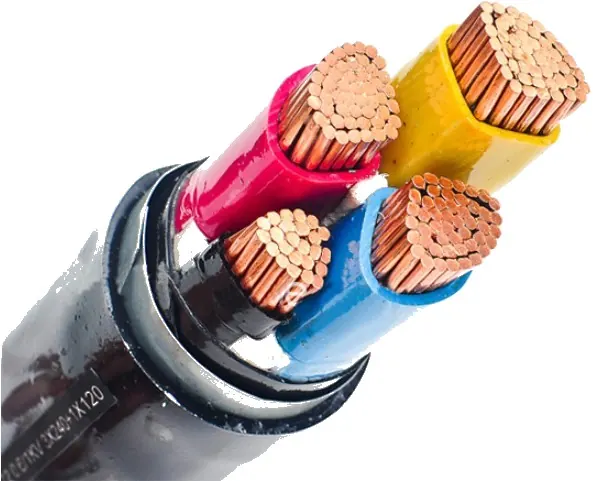
KVV and KYJV are 450/750 V multi-core control cables for fixed installation, typically 2–61 cores at 0.5–10 mm² with copper conductors. The difference is insulation: KVV uses PVC (about 70 °C continuous conductor temperature), while KYJV uses XLPE (about 90 °C), both normally with a PVC sheath. Choose KYJV where conductor or ambient temperature is higher; confirm exact ratings and fire performance on the datasheet.
KVV vs KYJV: the construction difference that sets the temperature rating
Both designations describe a control cable for fixed installation in control, signalling and interlock circuits. In the standard range the rated voltage is 450/750 V, conductors are copper class 1 or class 2, core count runs from 2 to 61, and cross sections are 0.5–10 mm². The products are commonly supplied to GB/T 9330 and IEC 60227. KVV means PVC insulation with a PVC sheath. KYJV keeps the PVC sheath but replaces the insulation with cross-linked polyethylene. In normal cable-engineering practice that changes the continuous permissible conductor temperature from about 70 °C for PVC to about 90 °C for XLPE — treat these as typical design values and verify the exact figure against the datasheet for the cable you are buying.
The insulation change does not automatically raise the voltage class: a KYJV cable is still normally a 450/750 V product, not a 0.6/1 kV power cable. XLPE insulation is mechanically a little harder, so the minimum bending radius during installation can be larger than for an equivalent PVC-insulated build; a commonly specified inner radius for fixed, non-armoured multicore cable is roughly 4–6 times the overall diameter, but the manufacturer's value governs. Neither KVV nor KYJV is screened by default. If the circuit sits next to variable-speed drives or contactors and carries low-level signals, ask for the screened variant (KVVP / KYJVP) or an instrumentation cable instead of assuming the basic designation includes a screen.
IEC 60227-1:2024 covers rigid and flexible PVC-insulated cables up to and including 450/750 V. Its code designations do not map one-to-one onto Chinese type letters, so a buyer comparing a GB/T 9330 datasheet with an IEC catalogue should ask for an explicit cross-reference rather than translating the letters literally. Flame-retardant versions exist in both families; request the relevant test report instead of relying on a catalogue badge.
How to choose core count, cross section and installation conditions
Start from the circuit list rather than from the cable name. Count every switched conductor, control lead and spare core, then pick a standard core count between 2 and 61. Cross section, usually 0.5–10 mm² in this family, is set by load current, permissible voltage drop, thermal withstand during a short circuit and minimum mechanical strength. On long cable runs voltage drop often decides before current rating does. Apply ambient-temperature, grouping and installation-method correction factors from the wiring-system rules (for example IEC 60364-5-52) instead of taking a single ampacity number from a table.
In practice, small switching and relay coils are often wired at 0.5–1.5 mm², while auxiliary and interlock circuits commonly use 1.5–2.5 mm². These are starting points, not a substitute for calculation. A circuit that genuinely carries motor or distribution current belongs on a properly rated power cable, not on a control cable chosen only because it has enough cores. Where the run is exposed to oil, sunlight, low temperature or specific flame-spread requirements, agree the sheath compound and test evidence explicitly; a standard PVC sheath is not automatically suitable for every environment.
Finally, separate fixed installation from movement. KVV and KYJV are built for static runs in trays, ducts or fixed clamp supports. A cable that travels with a machine axis or an energy chain needs a drag chain cable designed and tested for a defined number of bending cycles; using a fixed-installation control cable there usually ends in insulation cracking and conductor breakage. Making that distinction at the specification stage costs far less than replacing a cable after commissioning.
CE marking for cables: what buyers should know, and where CCC fits
CE marking for cables: what buyers should know first is that the mark is a manufacturer's declaration, not a universal performance certificate. EU Regulation 765/2008 defines it as a marking by which the manufacturer indicates that the product conforms to the applicable requirements set out in harmonisation legislation providing for its affixing. For a 450/750 V control cable, whether CE marking applies depends on the intended use and the legislation in scope — fixed building cables may fall under construction-product rules with a declaration of performance and a reaction-to-fire class, while other industrial cables may not carry the mark at all. Ask which legislation the declaration of conformity cites, and read the scope rather than the logo.
CCC certification for cable China explained in practical terms: CCC is a compulsory certification system applied to products listed in the official catalogue. A KVV or KYJV control cable is not automatically in scope merely because it is made in China, and a certificate for a different product type does not cover it. If a project or customs route asks for CCC, request a copy showing the exact product name, model, applicable standard, certificate number and validity, and confirm that the factory named on the certificate is the factory producing your order.
A sensible document pack for either family includes a datasheet with rated voltage, core count, cross section and temperature limits; type-test results for conductor resistance, voltage withstand and flame propagation; the conformity declaration where relevant; and any requested material compliance statements. Send the circuit list, installation method and destination market together — those three inputs determine both the right KVV/KYJV construction and the paperwork that should accompany it. Contact info@chuangshengcable.com or WhatsApp +86 17112662227 with the details.
Frequently asked questions
What is the difference between KVV and KYJV cable?
KVV has PVC insulation and a PVC sheath; KYJV has XLPE insulation with a PVC sheath. Both are typically 450/750 V, 2–61 cores and 0.5–10 mm². The practical difference is temperature: about 70 °C continuous conductor temperature for KVV versus about 90 °C for KYJV, subject to the datasheet.
How do I choose the cross section for a 450/750 V control cable?
Choose the cross section from load current, voltage drop, short-circuit thermal withstand and mechanical strength, then apply correction factors for ambient temperature, grouping and installation method. In the KVV/KYJV range sizes run from 0.5 to 10 mm²; long runs are often governed by voltage drop rather than current carrying capacity.
What should buyers know about CE marking for cables?
CE marking is the manufacturer's declaration that a product meets the applicable EU harmonisation legislation, not proof of third-party testing or a performance class. For control cables, check which legislation the declaration of conformity cites and whether a construction-product declaration of performance is required for the intended installation.
Is CCC certification for cable in China required for KVV or KYJV?
Not automatically. CCC applies to product categories listed in the official catalogue. If a project asks for it, obtain a certificate copy covering the exact KVV or KYJV model, standard and producing factory, and check validity. A certificate for another cable type does not cover your order.
Sources & attributed quotations
“IEC 60227-1:2024 applies to rigid and flexible cables with insulation, and sheath if any, based on polyvinyl chloride, of rated voltages Uo/U up to and including 450/750 V used in power installations of nominal voltage not exceeding 450/750 V AC.”
— International Electrotechnical Commission, IEC 60227-1:2024 — Polyvinyl chloride insulated cables of rated voltages up to and including 450/750 V, Part 1: General requirements · official source
“‘CE marking’ shall mean a marking by which the manufacturer indicates that the product is in conformity with the applicable requirements set out in Community harmonisation legislation providing for its affixing;”
— European Parliament and Council, Regulation (EC) No 765/2008, Article 2(20) — Accreditation and market surveillance relating to the marketing of products · official source