
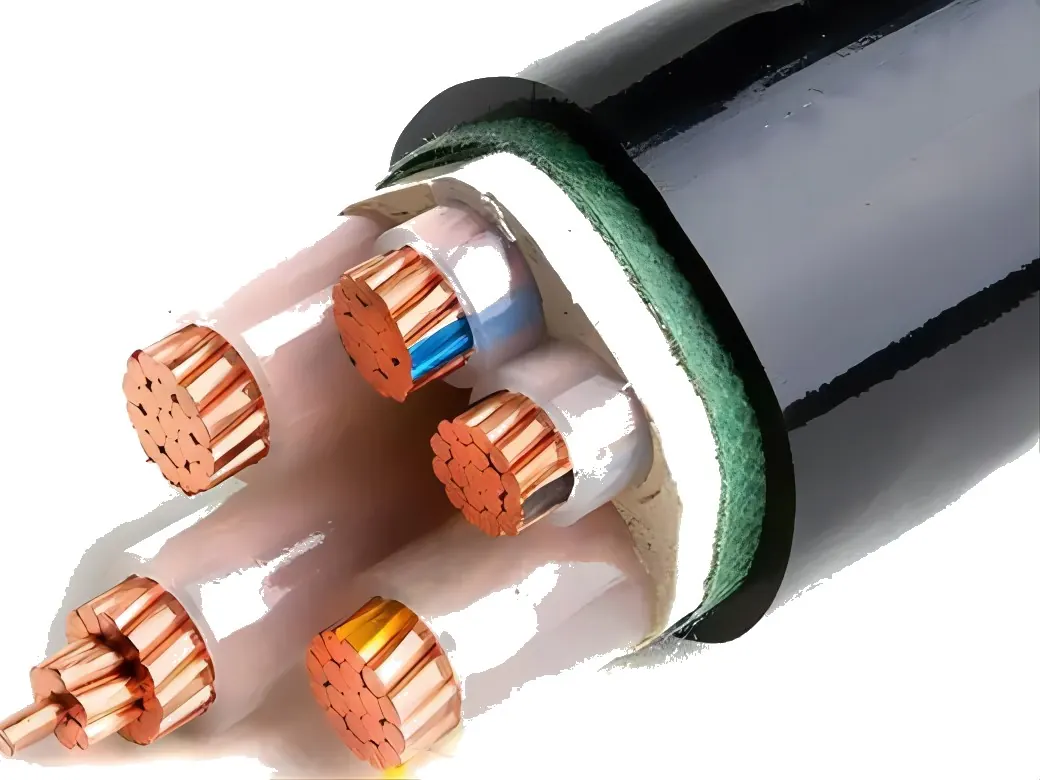
The difference between PV cable and normal cable is duty, not just insulation. A photovoltaic cable is a single-core, cross-linked insulated cable for the DC side of an array, commonly rated up to 1.5 kV DC, 90 C continuous conductor temperature and outdoor UV exposure. A normal 0.6/1 kV building cable may use PVC (70 C conductor) or XLPE (90 C), but is not automatically DC- or UV-rated. Check voltage, temperature, sheath and installation together.
Insulation first: what XLPE vs PVC actually changes
XLPE is cross-linked polyethylene: the polymer chains are chemically linked so the insulation keeps its shape at higher temperature. PVC is a thermoplastic that softens with heat. In the documented ranges on our site, XLPE insulated YJV / YJLV power cable is rated 0.6/1 kV with a maximum normal conductor temperature of 90 C and 250 C short-circuit temperature for up to five seconds; PVC insulated VV / VLV cable is also 0.6/1 kV but its maximum normal conductor temperature is 70 C. Both families are described to GB/T 12706 and IEC 60502-1, and both are shown with a 3.5 kV AC, five-minute test voltage. The higher thermal limit is why an XLPE cable of the same cross-section can carry more current under the same installation conditions.
That does not make PVC a poor choice. For indoor fixed installation, moderate load and projects where flame-retardant behaviour and cost matter, a PVC insulated 0.6/1 kV cable remains a normal, code-recognised solution. Choose XLPE when the cable runs warm, is buried or bundled, or when the design needs more ampacity from the same copper or aluminium cross-section. In either case the selection is not complete until you check voltage drop, short-circuit withstand, ambient temperature derating and the mechanical protection required by the route. Armoured versions add steel tape or steel wire for direct burial or areas with mechanical risk; sheath and armour choices are separate decisions from the insulation choice.
Why PV cable is not simply an XLPE power cable
IEC 62930:2017 applies to single-core cross-linked insulated power cables with cross-linked sheath used on the DC side of photovoltaic systems, with rated DC voltage up to and including 1.5 kV between conductors and between conductor and earth. The standard sets a normal continuous maximum conductor temperature of 90 C and limits use at 120 C to 20,000 hours. So a PV cable is cross-linked by design, but it is not interchangeable with a general XLPE distribution cable: it needs a UV-stabilised, weather-resistant sheath, insulation that tolerates outdoor temperature cycling, construction suitable for repeated handling on roofs, and clear DC polarity identification. The renewable-energy cable range documented on our site lists 0.6/1 kV for wind and 1.8 kV DC for PV, with XLPE insulation and UV-stabilised LSZH sheath to EN 50395 / IEC 62930 (PV); always confirm the exact datasheet rating against your string voltage.
If you are sourcing the best solar panel extension cable for outdoor UV resistant use, start with the same checklist: a PV-rated single-core cable, DC voltage class at or above the array maximum voltage, a sheath explicitly qualified for sunlight and weather, a stated continuous conductor temperature, and flexibility appropriate to the lowest site temperature. Check that connector type, polarity marking and strain relief suit the installation, and do not substitute an ordinary PVC flexible cord just because it looks similar. A normal cable may have adequate copper and insulation thickness yet still age quickly outdoors because its sheath was never evaluated for UV exposure. Ask the supplier for the test basis behind each claim rather than accepting the word solar on a catalogue page.
A practical specification checklist for buyers
Separate the three decisions before you request a quote. First, the system: AC distribution at 0.6/1 kV, or the DC side of a PV array. Second, the insulation and sheath: XLPE for a 90 C conductor limit and higher ampacity, PVC for a 70 C limit in ordinary indoor duty, or a UV-stabilised cross-linked construction for outdoor PV. Third, the mechanical and fire behaviour: unarmoured or armoured, LSZH or flame-retardant version, and bending radius. For example, the documented unarmoured YJV construction uses a bending radius of at least 15 times the outer diameter. For PV strings, confirm the standard basis, the DC rating, the sheath's outdoor qualification and the polarised marking, then check voltage drop over the full cable run.
Send the exact inputs so a supplier can check rather than guess: AC or DC and the maximum system voltage, conductor material and cross-section, number of cores, required current and length, installation method and ambient temperature, whether the route is exposed to sunlight, oil or mechanical risk, and any project standard that must be met. Certificate copies are available on request, and we will state clearly when a requested duty falls outside a documented product family. For a quotation or a technical check, write to info@chuangshengcable.com or WhatsApp +86 17112662227 with the parameters above; no price or certificate number should be assumed from a general guide like this one.
Frequently asked questions
What is the difference between PV cable and normal cable?
A PV cable is a single-core, cross-linked insulated cable designed for the DC side of a photovoltaic array: IEC 62930:2017 covers ratings up to 1.5 kV DC, a continuous 90 C conductor temperature and outdoor service. A normal 0.6/1 kV building cable may use PVC (70 C conductor) or XLPE (90 C) but is not automatically rated for DC voltage or ultraviolet exposure. Confirm the sheath and standard, not only the conductor size.
Is XLPE always better than PVC power cable?
Not always. XLPE allows a 90 C normal conductor temperature versus about 70 C for PVC in the documented 0.6/1 kV families, so it can carry more current at the same cross-section. PVC remains a sound, economical choice for ordinary indoor fixed installation where flame-retardant performance is required. Decide after checking load, ambient temperature, installation, voltage drop and short-circuit duty under the applicable IEC 60502-1 based specification.
How long can a PV cable operate at 120 C?
Under IEC 62930:2017 the normal continuous maximum conductor temperature is 90 C, and the permissible period at a maximum conductor temperature of 120 C is limited to 20,000 hours. Treat 120 C as an emergency or transient limit, not a continuous design point, and check how long your system could realistically dwell at that temperature over its service life.
What should I check for the best solar panel extension cable in outdoor UV resistant use?
Choose a PV-rated single-core cable with a DC voltage class at or above the array maximum, an explicitly UV- and weather-qualified sheath, a stated 90 C continuous conductor rating, low-temperature flexibility suited to the site, and connectors, polarity marking and strain relief that match the installation. Ordinary PVC flexible cord is not a substitute even when its cross-section looks adequate. Request the test basis for the UV and DC claims before ordering.
Sources & attributed quotations
“The cables are designed to operate at a normal continuous maximum conductor temperature of 90 °C. The permissible period of use at a maximum conductor temperature of 120 °C is limited to 20 000 h.”
— International Electrotechnical Commission, IEC 62930:2017 — Electric cables for photovoltaic systems with a voltage rating of 1,5 kV DC · official source
“IEC 60502-1:2021 specifies the construction, dimensions and test requirements of power cables with extruded solid insulation for rated AC voltages of 1 kV (Um = 1,2 kV) and 3 kV (Um = 3,6 kV) for fixed installations such as distribution networks or industrial installations.”
— International Electrotechnical Commission, IEC 60502-1:2021 — Power cables with extruded insulation, Part 1 · official source