
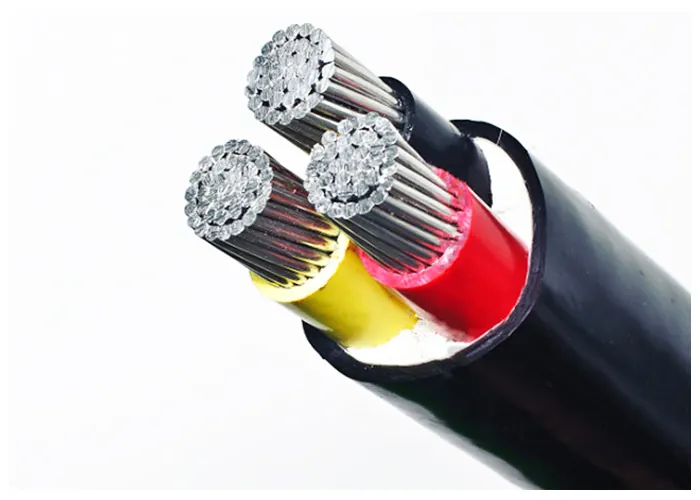
A YJV specification describes a 0.6/1 kV XLPE-insulated, PVC-sheathed power cable: copper conductors run from 1.5 to 400 mm², aluminium (YJLV) from 10 to 400 mm², with a 90 °C conductor limit, 250 °C for up to five seconds short-circuit and a 3.5 kV AC / 5 min test. Choose cross section from design current after temperature, grouping and installation derating, then check voltage drop and short-circuit withstand.
Reading a YJV cable specification without guessing
YJV is a code, not a mysterious number. In the documented range, YJ identifies cross-linked polyethylene insulation and V identifies a PVC outer sheath; adding L, as in YJLV, changes the conductor to aluminium. The family is supplied for 0.6/1 kV fixed distribution, with one, two, three, four or combined cores such as 3+1, 3+2 and 4+1. Copper cross sections run from 1.5 to 400 mm² and aluminium from 10 to 400 mm². Construction and tests follow GB/T 12706 and IEC 60502-1, including a 3.5 kV AC test for five minutes. Nothing in that code is a promise about ampacity until conductor size, installation and ambient conditions are stated.
Read the suffix with equal care. YJV22 and YJLV22 add steel-tape armour; YJV32 adds steel-wire armour, with further 23, 33, 42 and 43 variants listed in the range for different sheath and armour combinations. The unarmoured construction has a minimum bending radius of 15 times the overall diameter, which matters in cable trenches and building shafts. Sheath options include PVC (ST5) or LSZH polyolefin, and flame-retardant (ZR) or fire-resistant (NH) versions can be specified separately from the armour. An accredited type-test report is the right evidence for those claims: ask for the report itself rather than a catalogue badge. The only safe interpretation of a YJV cable specification is the complete datasheet for the exact variant you intend to buy.
How to choose cable cross section for current load
Selecting the cross section starts with the load, not with a catalogue size. Establish the design current, including starting currents where motors are involved, then apply correction factors for ambient temperature, grouping and the actual installation method: clipped direct, in a duct, on a tray or buried. The 90 °C continuous conductor limit of XLPE is a thermal ceiling, not a free ampacity multiplier. It helps, but a bundled cable in a warm plant room still needs derating. IEC 60364-5-52 deals with the selection and erection of wiring systems, and its 2024 consolidated edition explicitly revises sizing where harmonic currents are present. Treat harmonics as a real design input for variable-speed drives and IT loads.
Next, check voltage drop over the full route and the short-circuit duty. A conductor can pass a steady-state ampacity check yet fail because the far-end voltage sags, or because the insulation cannot withstand the let-through energy. The YJV range is stated at 250 °C short-circuit temperature for no more than five seconds, so the protective device and its clearing time must be coordinated with that limit. Where the run is long, a larger cross section may solve voltage drop more economically than changing cable type. Where copper cost dominates, YJLV aluminium from 10 mm² upward is an option, provided terminations and derating are reviewed for aluminium. Do not lift ampacity figures from a generic online table: conductor material, insulation, laying arrangement and soil thermal resistivity all change the answer.
For a quotation, send design current, route length, system voltage and earthing, installation method, maximum ambient temperature, grouping, permitted voltage drop and prospective short-circuit current. A supplier can then propose a cross section with a calculation basis and state clearly when a requested duty falls outside a documented product family.
Armoured vs unarmoured cable: when to use each
Armoured vs unarmoured cable is a mechanical question, not a status symbol. Unarmoured YJV is the normal choice for indoor fixed distribution in tray, conduit or protected duct, where the route is not exposed to impact and the bending radius can be respected. Steel-tape armour (22) is used where direct burial or mechanical protection is expected; steel-wire armour (32) is chosen where higher tensile forces must be resisted, such as certain vertical or buried runs. Armour is not a substitute for correct bedding, drainage or warning tape, and it does not by itself make a cable suitable for wet or chemically aggressive ground: the outer sheath and its documented rating decide that.
Fire behaviour and flexibility are separate decisions. For public or enclosed spaces, specify an LSZH sheath and the required flame-retardant or fire-resistant class instead of assuming a PVC sheath meets the project rule. Finally, do not stretch a fixed-installation power cable into duties it was not designed for: solar strings need a DC-rated photovoltaic cable to IEC 62930, typically up to 1.5 kV DC with a 90 °C conductor, and moving energy chains need a dedicated drag-chain cable with a stated bending-cycle flex-life rating. If your route includes either duty, request the corresponding product family rather than forcing YJV into the bill of materials.
Frequently asked questions
What does the YJV cable specification code mean?
In the documented range, YJ means XLPE insulation and V means a PVC outer sheath; YJLV uses an aluminium conductor instead of copper. YJV is a 0.6/1 kV fixed-installation cable with a 90 °C conductor limit, 250 °C short-circuit rating for up to five seconds and copper sizes from 1.5 to 400 mm². Suffixes such as 22 and 32 indicate steel-tape and steel-wire armour.
How to choose cable cross section for current load in a 0.6/1 kV YJV cable?
Start with design current, including motor starting current where relevant. Apply correction factors for ambient temperature, grouping and installation method, then verify voltage drop along the full route and short-circuit withstand against the 250 °C / 5 s limit. The 90 °C XLPE conductor rating supports higher ampacity than PVC at the same size, but it does not remove the need for derating. Use the applicable IEC 60364-5-52 sizing rules and the project's design data rather than a generic table.
Armoured vs unarmoured cable: when to use each?
Use unarmoured YJV for protected indoor routes such as trays or conduits, where impact risk is low and the 15-times-diameter bending radius can be kept. Choose steel-tape armour (22) for direct burial or mechanical protection, and steel-wire armour (32) where tensile forces are higher. Armour does not replace proper bedding or drainage, and sheath type must still be chosen for moisture, chemicals and fire behaviour.
Is YJV suitable for solar strings or drag-chain applications?
Normally no. A solar string needs a DC-rated photovoltaic cable designed to IEC 62930, typically up to 1.5 kV DC with a 90 °C continuous conductor and an outdoor-qualified sheath. A moving drag chain needs a dedicated flexible cable with a declared bending-cycle rating. YJV is a fixed-installation 0.6/1 kV cable; its XLPE insulation does not by itself qualify it for either duty.
Sources & attributed quotations
“IEC 60502-1:2021 specifies the construction, dimensions and test requirements of power cables with extruded solid insulation for rated AC voltages of 1 kV (Um = 1,2 kV) and 3 kV (Um = 3,6 kV) for fixed installations such as distribution networks or industrial installations.”
— International Electrotechnical Commission, IEC 60502-1:2021 — Power cables with extruded insulation, Part 1 · official source
“IEC 60364-5-52:2009+AMD1:2024 CSV deals with the selection and erection of wiring systems. This third edition cancels and replaces the second edition, published in 2001, and constitutes a technical revision.”
— International Electrotechnical Commission, IEC 60364-5-52:2009+AMD1:2024 CSV — Low-voltage electrical installations, Part 5-52: Selection and erection of electrical equipment, Wiring systems · official source